As organizations increasingly migrate their operations to the cloud, Enterprise Software as a Service (SaaS) has become a cornerstone of modern business infrastructure. From customer relationship management (CRM) platforms to project management tools and financial systems, SaaS applications enable scalability, flexibility, and cost efficiency. However, this shift also introduces new security challenges that organizations must address proactively.
Enterprise SaaS security is no longer optional—it is a critical component of business continuity, regulatory compliance, and customer trust. In this comprehensive guide, we will explore the fundamentals of SaaS security, common threats, best practices, and strategies enterprises can adopt to protect sensitive data in cloud-based systems.
What Is Enterprise SaaS Security?
Enterprise SaaS security refers to the set of policies, technologies, controls, and procedures designed to protect data, applications, and infrastructure within SaaS environments. Unlike traditional on-premise systems, SaaS platforms are hosted by third-party providers and accessed over the internet, which changes the security model significantly.
In a SaaS environment, security responsibilities are shared between the provider and the customer. This is often referred to as the shared responsibility model:
- SaaS Provider Responsibilities:
- Infrastructure security
- Network protection
- Data center security
- Application uptime and availability
- Customer Responsibilities:
- User access management
- Data protection and classification
- Endpoint security
- Compliance and governance
Understanding this division is crucial to building a robust SaaS security strategy.
Why SaaS Security Matters
1. Protection of Sensitive Data
Enterprise SaaS platforms often store critical business data such as financial records, intellectual property, and customer information. A breach can lead to severe financial and reputational damage.
2. Regulatory Compliance
Organizations must comply with regulations such as GDPR, HIPAA, and SOC 2. Failure to secure SaaS data can result in legal penalties and loss of business licenses.
3. Remote Workforce Risks
With remote and hybrid work becoming the norm, SaaS applications are accessed from multiple devices and locations, increasing the attack surface.
4. Increased Cyber Threats
Cybercriminals target SaaS platforms due to their centralized data storage and widespread use. Attacks such as phishing, ransomware, and account takeovers are common.
Common SaaS Security Threats
1. Data Breaches
Data breaches occur when unauthorized users gain access to sensitive information. This can happen due to weak passwords, misconfigured permissions, or vulnerabilities in the application.
2. Account Hijacking
Attackers use phishing or credential stuffing to gain access to user accounts. Once inside, they can steal data or manipulate systems.
3. Misconfiguration
Improper configuration of SaaS settings can expose data publicly or grant excessive permissions to users.
4. Insider Threats
Employees or contractors with legitimate access may intentionally or unintentionally compromise data security.
5. API Vulnerabilities
SaaS platforms rely heavily on APIs. If these APIs are not secured properly, they can become entry points for attackers.
6. Shadow IT
Employees may use unauthorized SaaS applications without IT approval, leading to unmanaged risks.
Key Components of SaaS Security
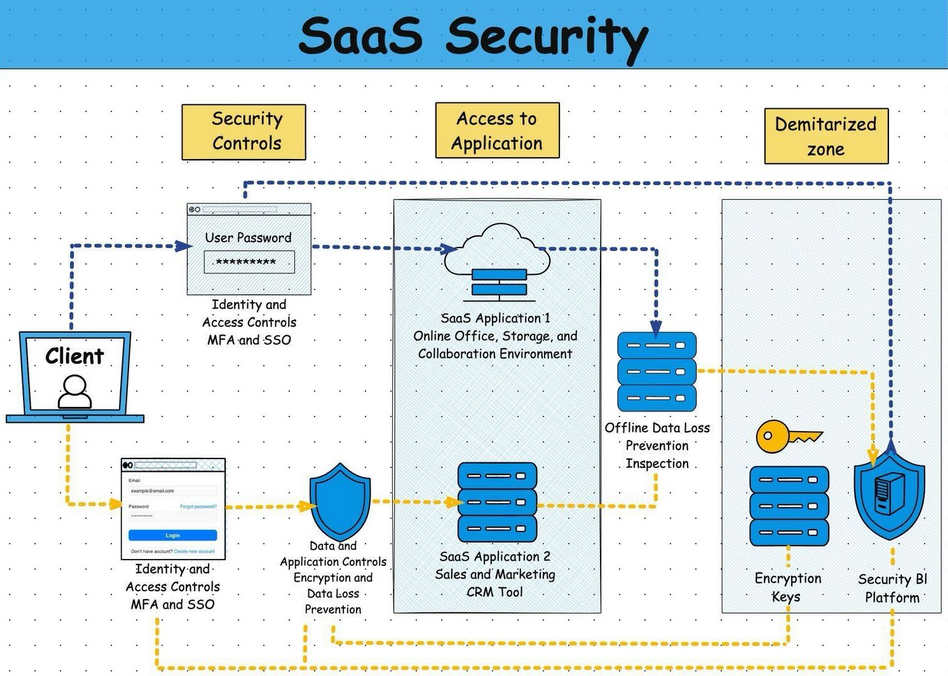
1. Identity and Access Management (IAM)
IAM ensures that only authorized users can access specific resources. It includes:
- Role-Based Access Control (RBAC)
- Multi-Factor Authentication (MFA)
- Single Sign-On (SSO)
Implementing strong IAM policies reduces the risk of unauthorized access.
2. Data Encryption
Encryption protects data both at rest and in transit. Even if attackers intercept the data, they cannot read it without the encryption keys.
3. Security Monitoring and Logging
Continuous monitoring helps detect suspicious activities early. Logging provides a record of events for auditing and investigation.
4. Data Loss Prevention (DLP)
DLP tools prevent sensitive data from being shared or leaked unintentionally.
5. Endpoint Security
Devices used to access SaaS applications must be secured with antivirus software, firewalls, and regular updates.
Best Practices for Enterprise SaaS Security
1. Implement Strong Authentication
Require Multi-Factor Authentication (MFA) for all users. This adds an extra layer of security beyond passwords.
2. Use Least Privilege Principle
Grant users only the access they need to perform their tasks. Avoid giving administrative privileges unnecessarily.
3. Regularly Audit Access Controls
Conduct periodic reviews of user roles and permissions to ensure they align with current responsibilities.
4. Encrypt Sensitive Data
Ensure that all sensitive data is encrypted both in transit (using HTTPS) and at rest.
5. Monitor User Activity
Use analytics tools to detect unusual behavior, such as logins from unfamiliar locations or large data downloads.
6. Secure APIs
Implement authentication, rate limiting, and encryption for all APIs used by your SaaS applications.
7. Train Employees
Human error is a major cause of security incidents. Provide regular training on phishing awareness and security best practices.
8. Backup Data Regularly
Even with SaaS providers, having independent backups ensures data recovery in case of accidental deletion or ransomware attacks.
Advanced SaaS Security Strategies
1. Zero Trust Architecture
Zero Trust assumes that no user or device should be trusted by default, even if they are inside the network. Every access request must be verified.
Key principles include:
- Continuous authentication
- Micro-segmentation
- Device verification
2. Cloud Access Security Broker (CASB)
A CASB acts as a security layer between users and SaaS applications. It provides:
- Visibility into SaaS usage
- Data protection
- Threat detection
- Compliance enforcement
3. Security Information and Event Management (SIEM)
SIEM systems collect and analyze security data from multiple sources to identify threats in real time.
4. Automated Security Tools
Automation helps detect and respond to threats faster. Tools can automatically block suspicious activities or alert administrators.
Compliance and Governance
1. Understanding Regulations
Organizations must identify which regulations apply to their industry and ensure compliance. Common standards include:
- GDPR (data protection in Europe)
- HIPAA (healthcare data in the US)
- ISO 27001 (information security management)
2. Data Classification
Classify data based on sensitivity levels (e.g., public, internal, confidential). This helps apply appropriate security measures.
3. Regular Audits
Conduct internal and external audits to ensure compliance with security policies and regulations.
Challenges in SaaS Security
1. Lack of Visibility
Organizations may not have full visibility into how SaaS applications are used, especially with shadow IT.
2. Integration Complexity
Integrating multiple SaaS applications can create security gaps if not managed properly.
3. Rapid Scaling
As businesses grow, managing user access and data security becomes more complex.
4. Vendor Dependency
Organizations rely on SaaS providers for infrastructure security, which can be risky if the provider has vulnerabilities.
Future Trends in SaaS Security
1. AI-Powered Threat Detection
Artificial intelligence is increasingly used to detect anomalies and predict potential threats.
2. Increased Regulation
Governments are introducing stricter data protection laws, requiring organizations to enhance security measures.
3. Secure Access Service Edge (SASE)
SASE combines networking and security functions into a single cloud-based service, improving performance and protection.
4. Privacy-First Architecture
Organizations are prioritizing user privacy by design, integrating security into every stage of application development.
Building a SaaS Security Framework
To effectively secure SaaS environments, organizations should adopt a structured framework:
Step 1: Assess Risks
Identify potential vulnerabilities and evaluate the impact of different threats.
Step 2: Define Policies
Create clear security policies covering access control, data handling, and incident response.
Step 3: Implement Controls
Deploy security tools and technologies such as IAM, encryption, and monitoring systems.
Step 4: Educate Employees
Ensure all users understand their role in maintaining security.
Step 5: Monitor and Improve
Continuously monitor systems and update security measures based on emerging threats.
Incident Response in SaaS Environments
Even with strong security measures, incidents can still occur. A well-defined incident response plan is essential:
1. Detection
Identify the breach or suspicious activity as quickly as possible.
2. Containment
Limit the impact by isolating affected systems or accounts.
3. Investigation
Analyze logs and data to understand the cause and scope of the incident.
4. Recovery
Restore systems and data to normal operations.
5. Lessons Learned
Update security policies and controls to prevent similar incidents in the future.
Conclusion
Enterprise SaaS security is a critical aspect of modern business operations. As organizations continue to adopt cloud-based systems, the need to protect sensitive data becomes increasingly important. By understanding the shared responsibility model, implementing best practices, and adopting advanced security strategies, businesses can significantly reduce their risk exposure.
A proactive approach to SaaS security—combining technology, processes, and employee awareness—ensures not only compliance but also long-term resilience in an evolving threat landscape. Investing in robust security measures today will safeguard your organization’s data, reputation, and future growth in the digital era.
Final Thoughts
The shift to SaaS is inevitable, but security risks do not have to be. With the right strategies in place, organizations can enjoy the benefits of cloud-based systems while maintaining strong data protection. Enterprise SaaS security is not a one-time effort—it is an ongoing process that requires continuous improvement and vigilance.
By prioritizing security at every level, from infrastructure to user behavior, businesses can confidently navigate the complexities of the cloud and build a secure, scalable, and future-ready digital ecosystem.